2026 International Ultrasonics Symposium Challenge
October 4-8, 2026 | Raleigh, North Carolina, USA
Pulse-echo quantitative ultrasound (QUS) is a well-established research field. Studies have demonstrated the diagnostic values of QUS features in a wide range of clinical and preclinical applications. In the past ten years, major medical ultrasound companies have introduced commercial implementations of QUS features motivated by their potential as indicators of fatty liver disease.
Despite the increasing interest in QUS, important challenges remain, most importantly the need to compensate for the effects of intervening tissues between the transducer and the tissue of interest. To address these challenges, novel QUS methods have been investigated to improve the compensation for total attenuation along the acoustic path and to reduce the effects of aberration through estimation of the speed of sound.
Numerous algorithms and methods exist, and the time has come to compare and evaluate them in a rigorous matter. The proposed challenge will provide (i) a wide platform to bring together research efforts from laboratories across the globe and (ii) a framework to compare the QUS algorithms developed by these laboratories in a uniform and standardized manner. Based on ultrasound data generated from realistic simulations and acquired from phantoms with known acoustical properties, participants will compete to develop the most accurate and precise methods (in terms of bias and variance) and with the best lesion detectability.
OBJECTIVES
Overall Goal: Provide a uniform framework to compare the performance of different attenuation and speed of sound estimation algorithms over a wide range of expected values.
- Specific objective 1: Identify the algorithms that provide the most accurate and precise estimates of the attenuation coefficient and speed of sound over a wide range of conditions using radio-frequency (RF) data from computational and experimental phantoms.
- Specific objective 2: Identify the algorithms that provide the best lesion detectability, i.e., able to detect the smallest spatial variation of attenuation or speed of sound.
- Specific objective 3: Identify the algorithms that provide the most robust estimates of attenuation and speed of sound to the presence of near-field aberration.
FINAL SCORES
Attenuation estimation
| Lead author | Institution | Country | Score | Rank |
| Esteban Aviles | Pontificia Universidad Catolica del Peru | Peru | 0.024 | 1 |
| Chulhong Kim | POSTECH | South Korea | 0.030 | 2 |
| Yooseok Lim | University of Massachusetts, Amherst | United States | 0.038 | 3 |
| Mekdes Wubet Bezabh | University of North Carolina at Charlotte | United States | 0.038 | 3 |
| Wei-Ning Lee | The University of Hong Kong | China | 0.046 | 4 |
| Soumik Shanto Mondol | Concordia University | Canada | 0.053 | 5 |
| Ahmed El-Kaffas | University of California San Diego | United States | 0.072 | 6 |
| Huidong Yang | University of Vienna | Austria | 0.200 | 7 |
| Meng-Lin Li | National Tsing Hua University | Taiwan | 0.316 | 8 |
Speed of Sound Estimation
| Lead author | Institution | Country | Score | Rank |
| Rehman Ali | University of Rochester | United States | 22.607 | 1 |
| Scott Schoen Jr and Gaungyi Zhang | Georgia Tech | United States | 28.660 | 2 |
| Changting Xu | Qualcomm | United States | 31.679 | 3 |
| Jonathan Langdon | Yale University | United States | 36.447 | 4 |
| Baptiste Heriard-Dubreuil | Institute Langevin | France | 52.004 | 5 |
| Di Xiao | University of Waterloo | Canada | 54.751 | 6 |
| Huidong Yang | University of Vienna | Austria | 57.608 | 7 |
| Minho Song | Stanford University | United States | 71.872 | 8 |
| Michael Jaeger | University of Bern | Switzerland | 72.514 | 9 |
| Mohammad Wasih | The Pennsylvania State University | United States | 125.065 | 10 |
| Yunlong Zhu | Johns Hopkins University | United States | 183.671 | 11 |
March 16, 2026: Registration to access data open
March 27, 2026: Data release
May 3, 2026: Results upload by participants
May 3, 2026: Abstract deadline, same as all abstracts
NEW: May 17, 2026: Results upload by participants
June 21, 2026: Acceptance notifications sent
October 4 -8, 2026: During the conference all accepted participants will have their posters on site during the Challenge poster session, the top three in each category (i.e., speed of sound and attenuation) will present their work during the Challenge oral session. Award ceremony will be at the end of the oral session
EMAIL FROM 4/27/2026
- We recently noted a sampling issue in the Group B dataset. We have therefore uploaded a revised dataset denoted as Group D. We have also included corresponding reference data. The README file has been updated with these details (attached and on Globus). Please disregard all data in Group B.
- Regarding reporting the values of attenuation, the frequency for reporting specific attenuation slightly differs for Group D compared to Groups A and C. Please refer to the “Submitting Results” section in the README for further instructions. The specific attenuation is computed as the attenuation coefficient at each frequency in dB/cm divided over the frequency. The final units will be dB/cm-MHz.
- We have extended the results submission deadline two additional weeks (New results due date: May 17th). You should have received an individual folder to upload your results to Globus. Please contact us if you have not received the link to your folder. Of note, the abstract submission date is still May 3rd
- Scoring and winners will be determined based on the data submitted on May 17th. To be considered for scoring, the abstract must be submitted BY THE DEADLINE and accepted. The abstract needs to describe the algorithm, how it was implemented on the PEQUS data, and how its performance was evaluated (without knowing ground truth).
EMAIL FROM 4/15/2026
A few important announcements regarding the data and abstract submission for IUS:
- An issue with the L11-5v datasets in group C was brought to our attention. While investigating the issue and a potential correction, we traced the error to a fault during the acquisition process that cannot be fixed. Therefore, all L11-5v datasets in group C will be omitted from final evaluations. We also found the issue affects Dataset_14_L115_A.mat. You will not be required to upload results for these datasets. To avoid any ambiguity, the attached .csv contains the specific names of the affected files that will not be used for evaluation.
- During the course of the above investigation, we found the first two dimensions of the RF data arrays were permuted compared to the information on the QUASOS website and README on Globus. In the uploaded challenge data, the first dimension of the array actually indexes the receive elements whereas the second dimension indexes the transmitting elements. The README (attached) has been corrected and the website text will be updated to reflect this.
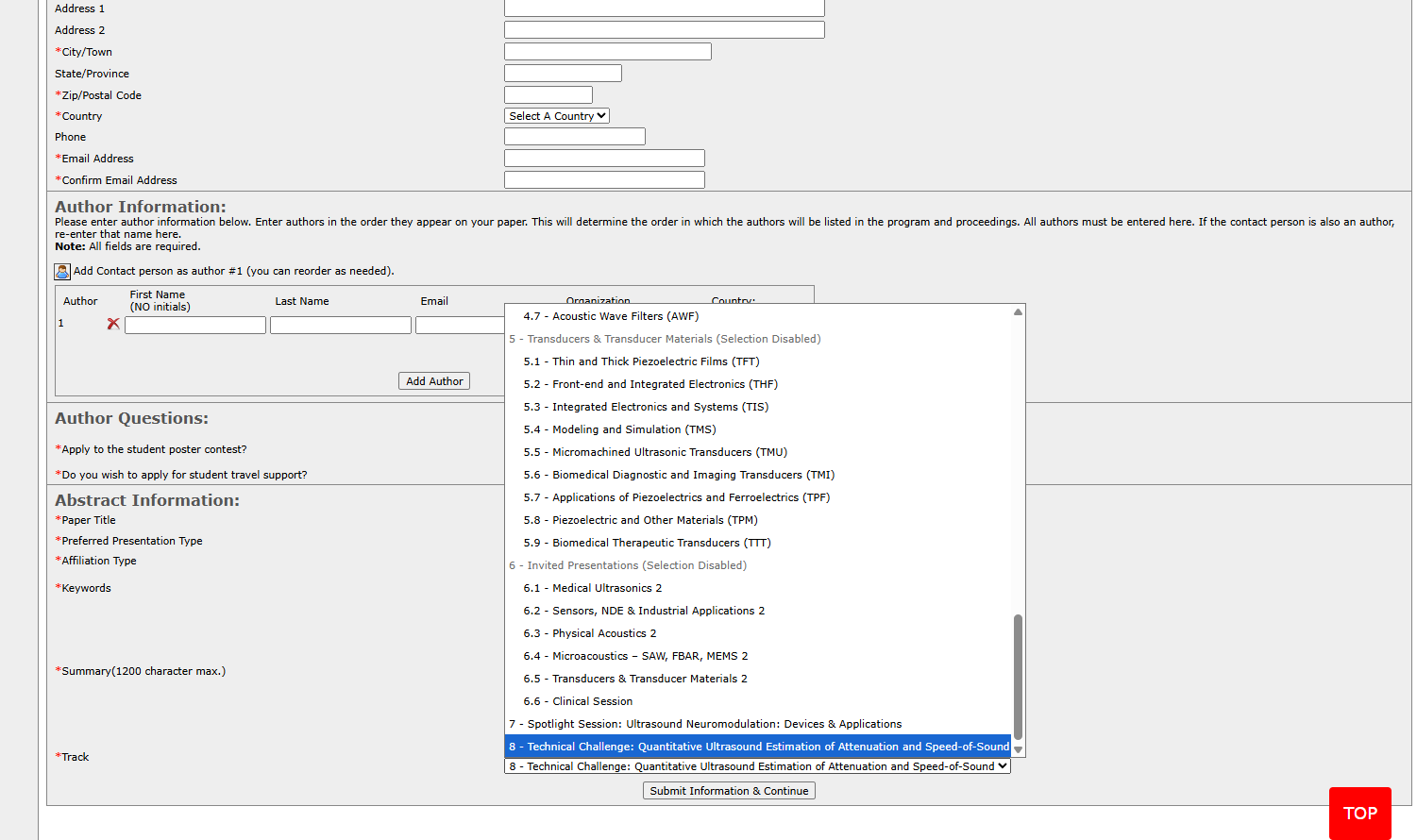
- Finally, during abstract submission for IUS, participants must select Track 8, “Technical Challenge – Quantitative Ultrasound Estimation of Attenuation and Speed-of-Sound”. Please see the screenshot below for reference.
Data format: The downloaded Matlab data are named “Dataset_1_ L74.mat” to “Dataset_N_ L74.mat” and “Dataset_1_L115.mat” to “Dataset_N_L115.mat”. The order and the names of files have no meaning except the suffix indicates what transducer was use (_L74 and _L115 for L7-4 and L11-5, respectively). Each mat file contains the full transmit receive RF matrices of size 128 by 128 by Number of time samples. The first and second dimensions are the receive and transmit element, respectively, and the third dimension is time sampled at the rate specified in a structure variable also describing the properties of the transducers. With this, the participants are completely blind to the nature of the data
Result format: Participants must adhere strictly to the following format for their results. Participants can submit results for SoS or Att or both following the following guidelines:
Results mat files should be named as “Result_k_L74_(A|B|C)_SoS”, “Result_k_L74_(A|B|C)_Att”, “Result_k_L115_(A|B|C)_SoS”, or “Result_k_L115_(A|B|C)_SoS”, where k is the index of the input file used to generate the results and (A|B|C) indicates the dataset group. For example, the speed of sound result file name for dataset 4 in group B collected with the L11-5v must be named Dataset_4_L115_B_SoS. Each .mat file must contain a 2D matrix of size 601 × 351, representing a 6 × 3.5 cm field with an isotropic grid spacing of 0.01 cm laterally centered on the probe. Speed of sound values must be in m/s. Attenuation values should be reported in units of dB/cm/MHz (specific attenuation), defined as attenuation (dB/cm) normalized by frequency. The frequency is defined as 5 MHz for L7-4 and 8 MHz for L11-5 .
Results upload: Follow guidelines provide during registration to upload your result matrices. Scoring will be performed independently on SoS and Att results matrices, but you must submit all .mat files for the category you are participating in to be scored.
Prizes
Top three in each category will receive prizes during IUS 2026. We are thankful to our sponsor Verasonics for providing the awards and to our sponsor AIUM / QMIC – Pulse Echo Quantitative Ultrasound Biomarker Committee for providing the phantoms.
Results
Results will be posted after abstract submissions.
Abstract submission
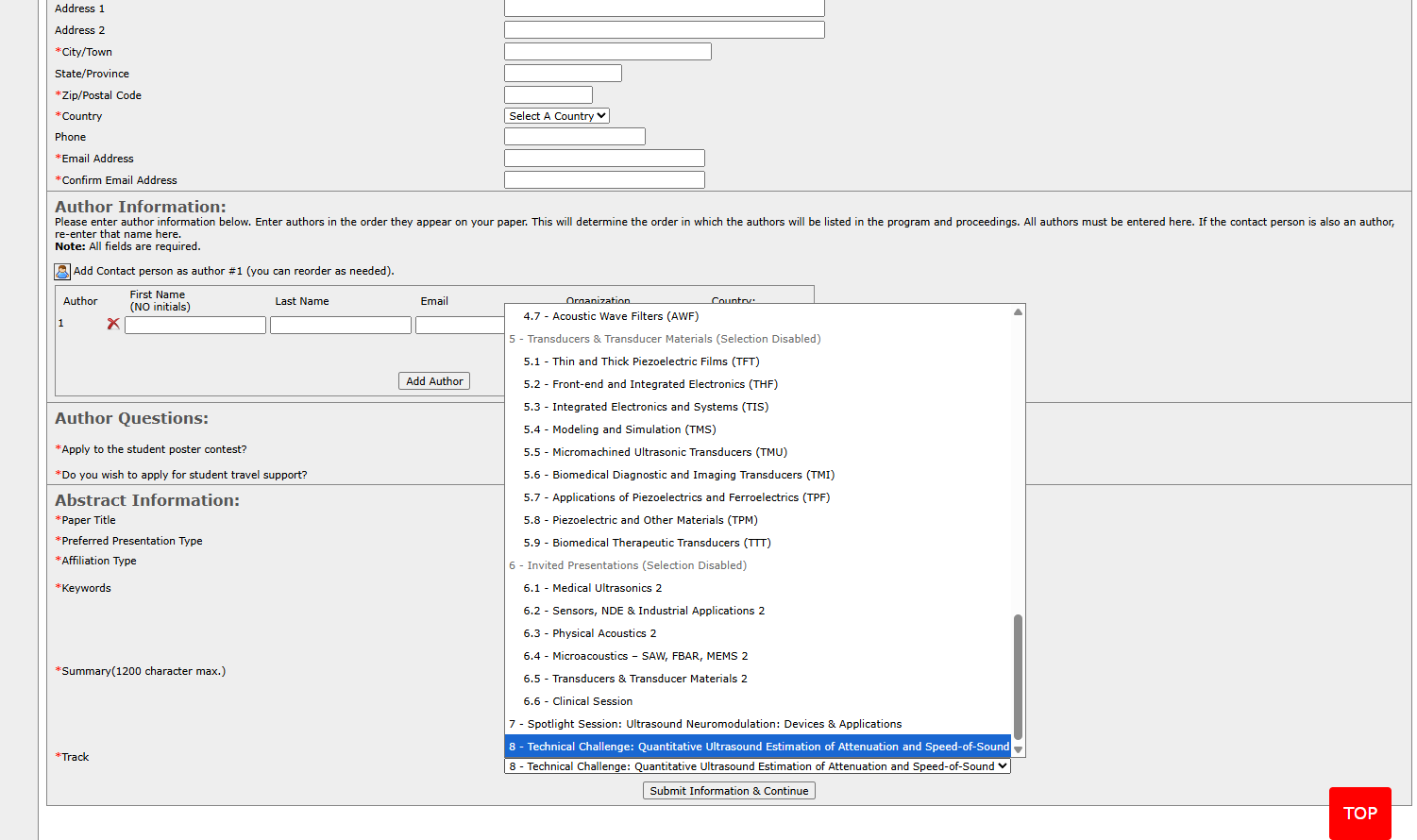
Participants must submit their abstract using Track 8 as shown in the below screen capture:
Scoring
Submissions to the QUASOS challenge will be scored independently for speed of sound and attenuation. We will reveal the complete scoring scheme shortly following the submission deadline (May 17) because we do not want to provide any additional details regarding the datasets to participants at this time, but we can state that:
- The scoring will be entirely based on the root mean square errors (RMSEs) between the ground truth and the results provided by the participants for each result file.
- RMSEs across all datasets will be averaged between Set D (RMSE_avD) and Sets A/C (RMSE_avAC).
- The final score will be S = 1/3 * RMSE_D + 2/3 * RMSE_avAC.
(The lower S, the better the performance. The three lowest scores for SoS and Att estimation will receive awards.)
Prizes
Top three in each category will receive prizes during IUS 2026. We are thankful to our sponsor Verasonics for providing the awards and to our sponsor AIUM / QMIC – Pulse Echo Quantitative Ultrasound Biomarker Committee for providing the phantoms.
Results
Results will be posted after abstract submissions.
ORGANIZERS
Cameron Hoerig, PhD
Instructor of Biomedical Engineering in Radiology
Department of Radiology
Weill-Cornell School Medicine
Ivan Rosado-Mendez, PhD
Assistant Professor
Departments of Medical Physics and Radiology
University of Wisconsin–Madison
Jonathan Hale, MSc
University of Wisconsin – Madison
Zixhuan Tian, PhD
Virginia Tech
Cristel Baiu, MSc
University of Wisconsin–Madison
Have questions about challenge?
SPONSORS