
Want a phantom?
A phantom tradition
For more than 50 years, the Department of Medical Physics as been at the forefront of the development of tissue mimicking materials for different imaging modalities; ultrasound is not the exception. The pioneering work from Dr. Ernie Madsen and Gary Frank on the development of water-based gels for different modes of ultrasound imaging and Dr. Tim Hall for contrast-detail analysis and elastography, is now being expanded by the expertise of Cristel Baiu and the leadership of Drs. Rosado-Mendez and Hall. Our mission is to advance research in phantom development and provide the ultrasound community with customized and extensively characterized phantoms adapted to each research enterprise.
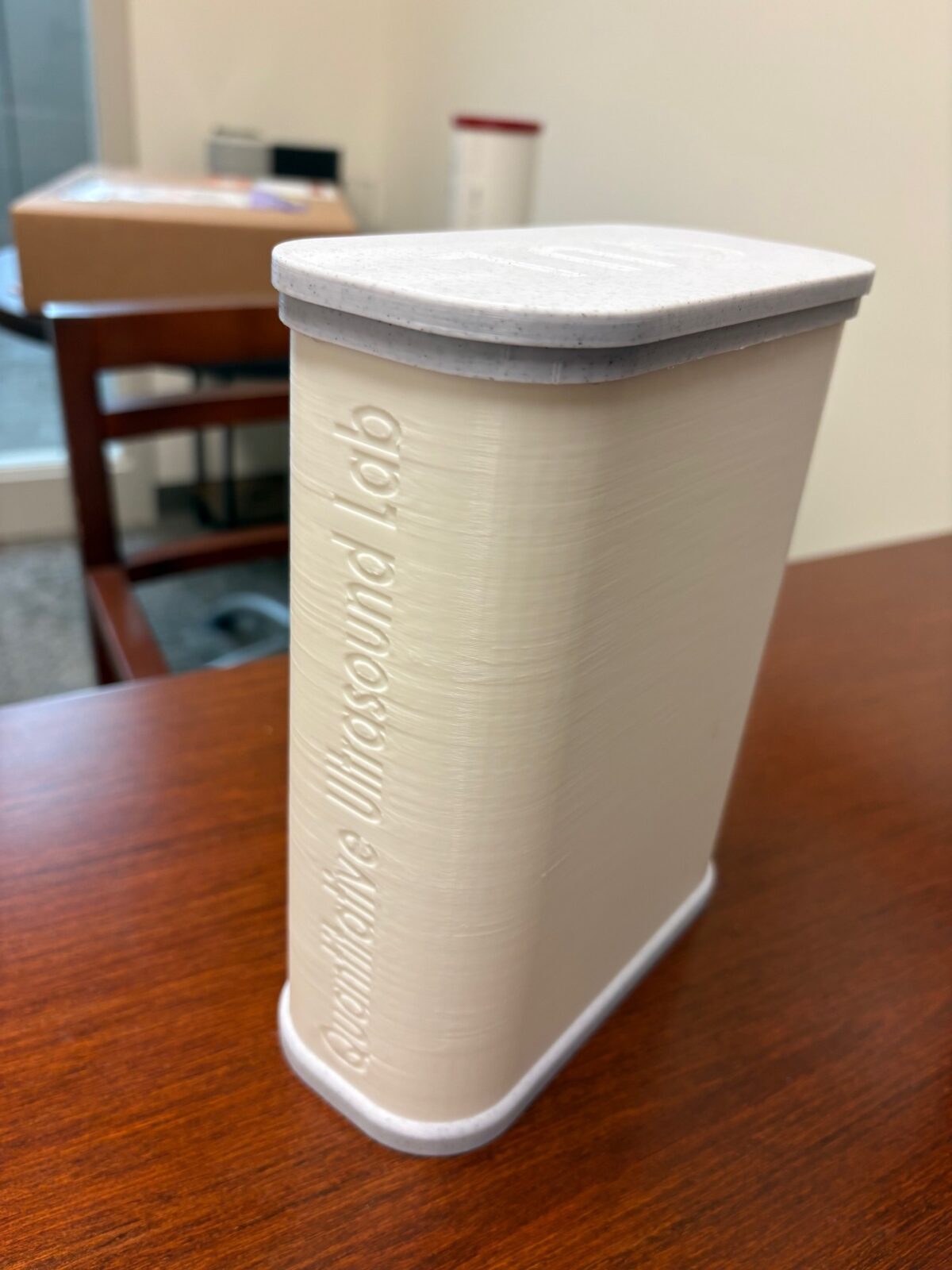
Types of phantoms
High-dynamic range phantoms
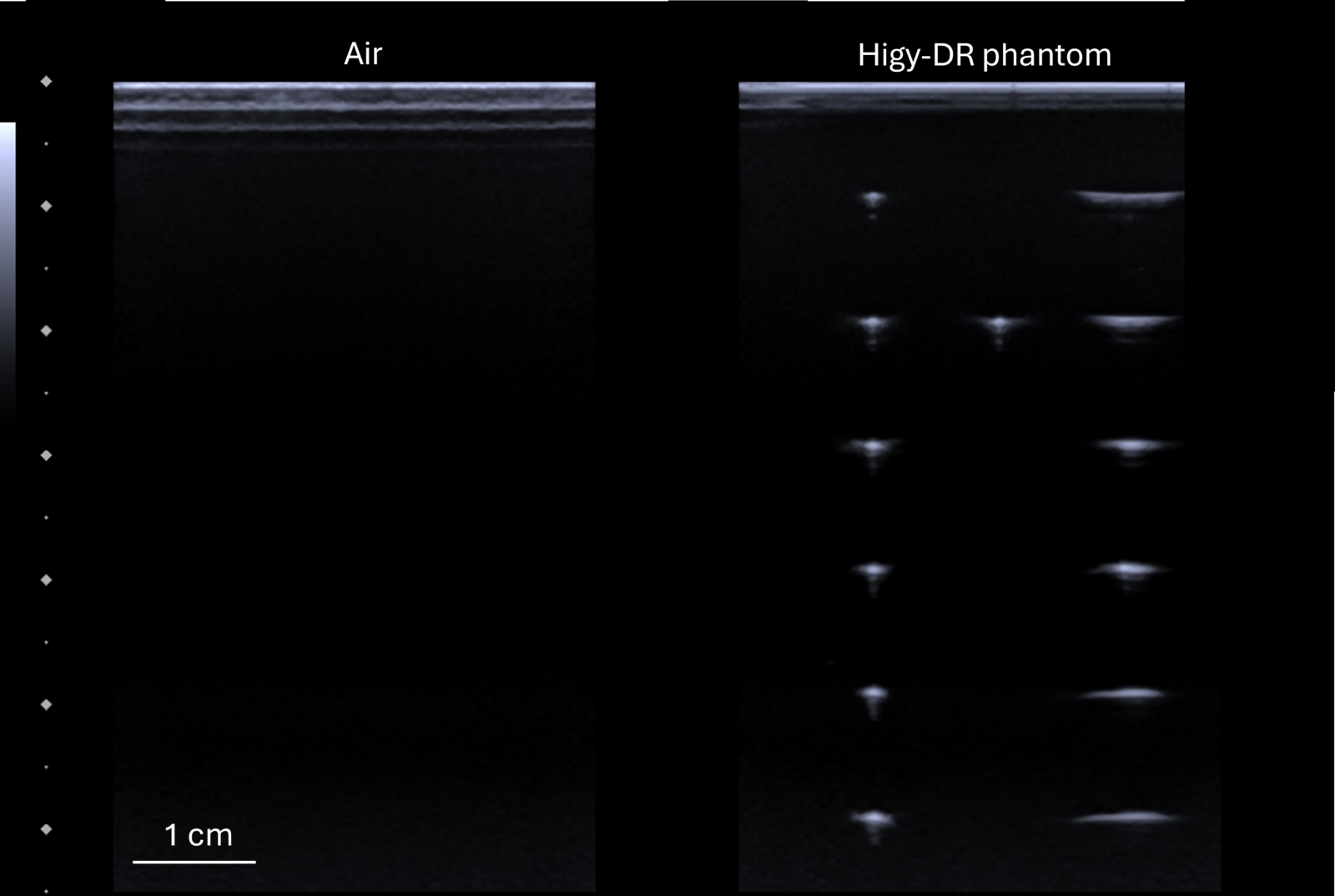
The HDR phantom is composed of highly echogenic fibers embedded in an anechoic background ideal for evaluation of point spread functions created by different beamforming strategies.
- Background attenuation: 2.54 ± 0.04 dB/cm at 5MHz
- Background speed of sound at 5MHz: 1534.8 ± 0.6 m/s
- Echogenicity of anechoic background relative to acrylic reflector: -53.7 ± 4.4 dB
- Echogenicity of deionized water relative to acrylic reflector: -52.2 ± 4.6 dB
The acoustic properties of the background and the diameter, composition, and position of the fibers can be customized.
Pulse-Echo Quantitative Ultrasound
The pulse-echo quantitative ultrasound phantoms are made of a water-based gel with micron-sized glass beads to carefully controlled the magnitude and frequency dependence of the attenuation coefficient, the backscatter coefficient, and the speed of sound.
The acoustic properties of the tissue-mimicking materials, including the speed of sound, attenuation, and magnitude and frequency dependence of backscatter, can be tuned to match specific needs. These properties can be characterized within 1 and 20MHz using immersion based substitution techniques. Due to high demand of these phantoms, a standard set consisting of three phantoms is available with the following properties (averages within tolerances).
| Phantom | Specific attenuation @ 3MHz dB/cm-MHz | Speed of sound m/s | Backscatter coefficient 1/cm-Sr |
| 1 | 0.5 | 1560 | 10E-5 |
| 2 | 0.7 | 1540 | 10E-4 |
| 3 | 0.9 | 1500 | 10E-3 |
Vascular phantoms
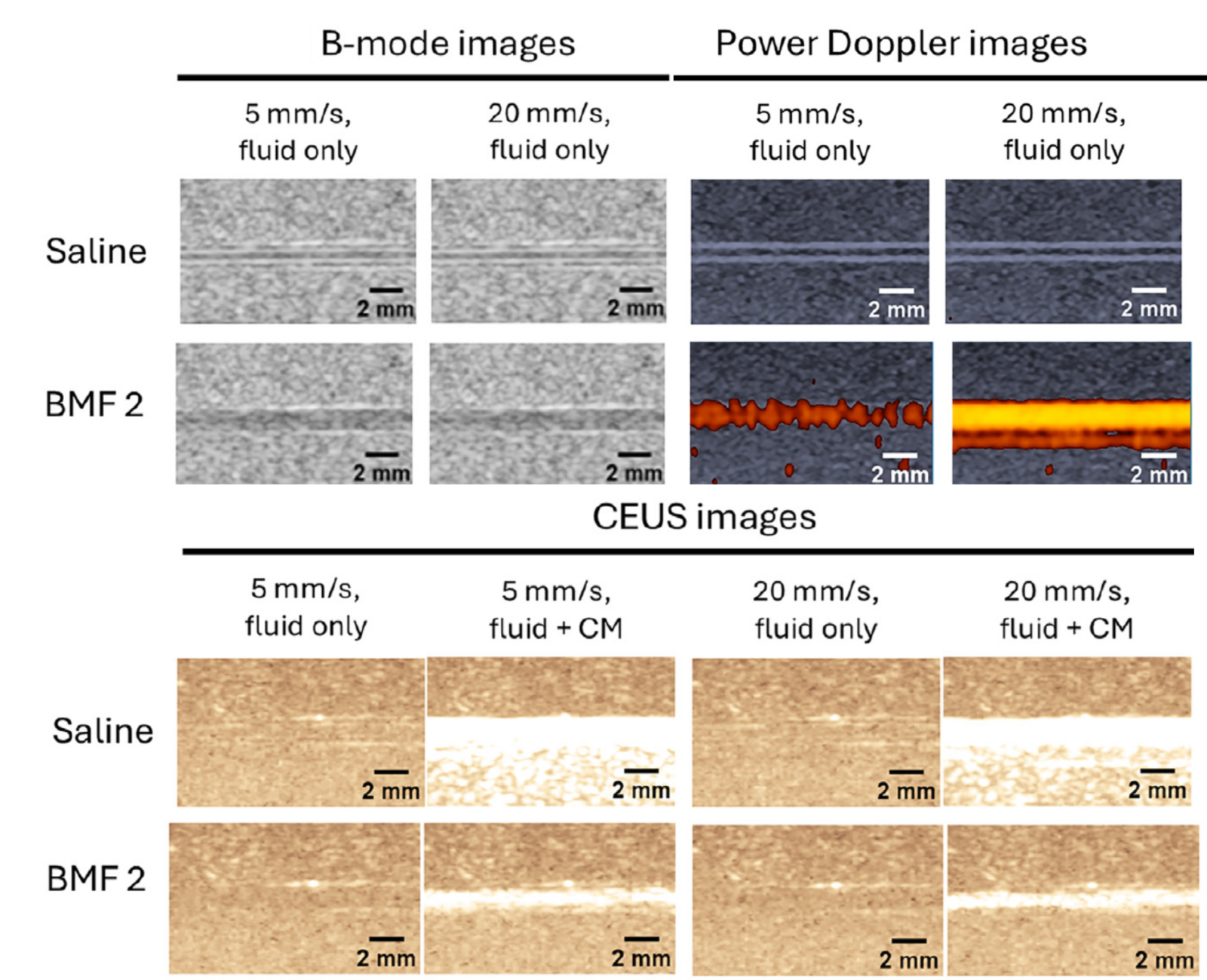
Our vascular phantoms contain tubing down to 100 microns in diameter and a blood-mimicking fluid (BMF) with calibrated density, viscosity, attenuation coefficient, speed of sound, and scatterer buoyancy. More information can be found in our recent publication in Ultrasound in Medicine and Biology. This fluid is compatible with contrast enhanced ultrasound as indicated in the figure above.
Customized phantoms
We are happy to meet with you to discuss your needs. Some specific phantoms characteristics that we can recreate are the following:
- Phantoms with anisotropic structures (10.1109/TUFFC.2025.3562784)
- Phantoms with inclusions of different sizes and acoustic properties (speed of sound, backscatter coefficient, attenuation)
- Layered phantoms with depth-wise variations of acoustic properties
- Phantoms with different stiffness for evaluating elastography